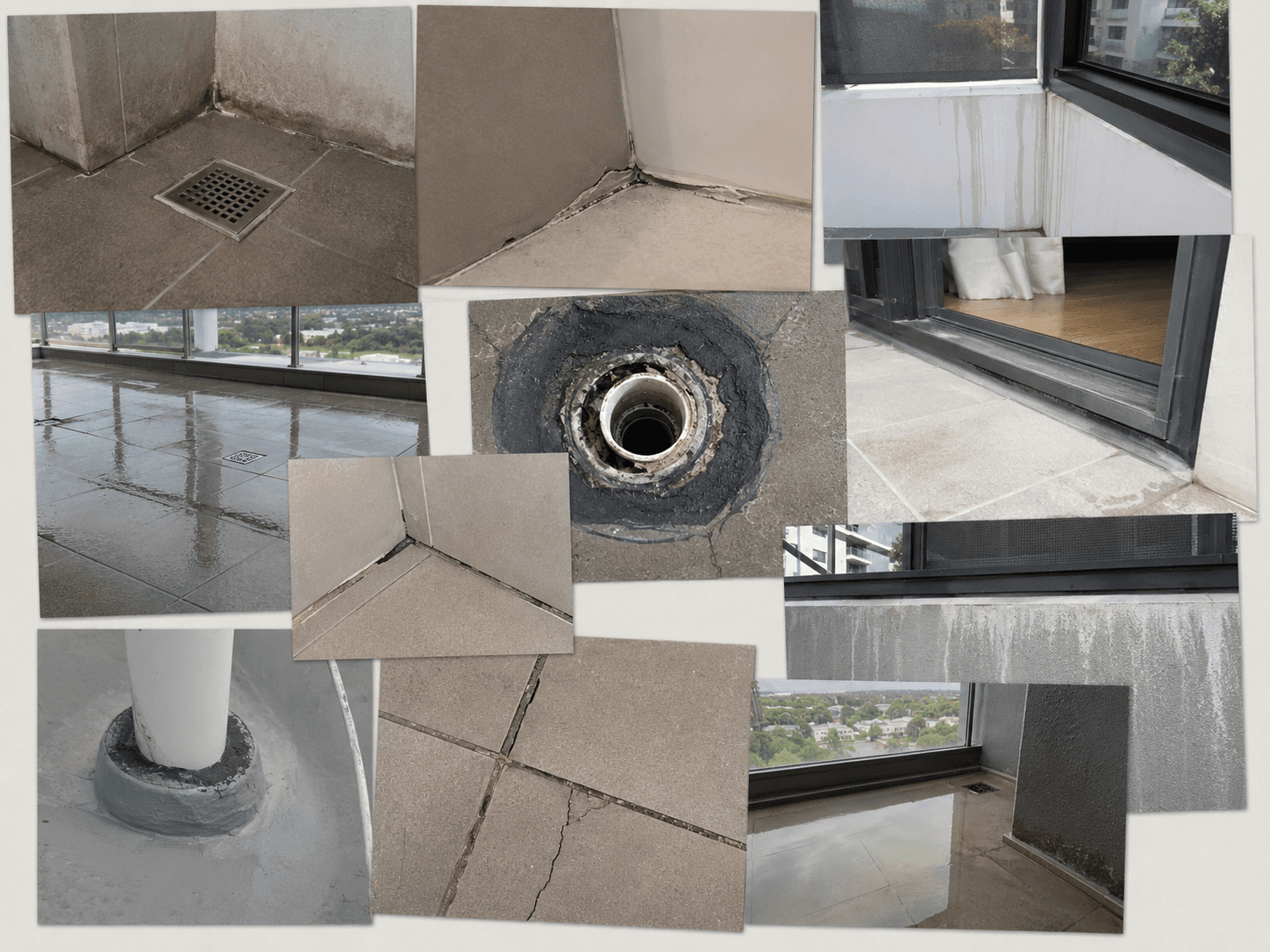
Common Waterproofing Defects in New Apartments
Waterproofing defects are among the most common and costly issues in new apartment developments — and most stem from poor detailing, substrate prep or drainage rather than the membrane product itself. This guide walks through the twelve most common failure points, from falls and terminations to penetrations and pre-cover inspection, and why remediation must fix the cause, not just the visible symptom.
Waterproofing defects are among the most common and costly building issues encountered in new apartment developments. A relatively small defect in a membrane, drainage outlet or termination detail can allow water to migrate into adjoining finishes, wall cavities and structural elements, often causing damage well beyond the original point of failure.
In Australia, waterproofing requirements are addressed through the National Construction Code (NCC) and the Australian Standards it references. The applicable standard depends on where the waterproofing is located. Internal wet areas — bathrooms, ensuites, laundries and WCs — fall under AS 3740:2021 – Waterproofing of domestic wet areas, which sets minimum requirements for waterproofing materials, design and installation in residential buildings (including Class 1 and Class 2). External above-ground surfaces — balconies, terraces, roofs, podiums, planter boxes and similar — instead fall under AS 4654.2 – Waterproofing membranes for external above-ground use (Design and installation), with material requirements in AS 4654.1.
This distinction matters, because many of the most damaging apartment leaks occur on balconies, terraces and roofs, which are governed by AS 4654 rather than the wet-area standard.
In practice, many waterproofing failures are not caused by the membrane product itself. They result from poor detailing, inadequate substrate preparation, incorrect drainage, construction damage or failure to coordinate waterproofing with other building elements.
Below are some of the most common waterproofing defects found in new apartment buildings.
1. Inadequate Falls and Ponding Water
Balconies, terraces, rooftops and wet areas need to direct water effectively towards drainage points.
Common problems include:
- Insufficient falls towards floor wastes or outlets
- Localised low points within screeds
- Drainage outlets positioned higher than surrounding surfaces
- Ponding around balcony edges, door thresholds or penetrations
- Finished tiles laid with falls that conflict with the underlying waterproofing system
Persistent ponding increases the period that the waterproofing system remains exposed to water and can expose weaknesses in membrane joints, penetrations and terminations.
Correcting the membrane alone may not resolve the problem if the underlying drainage geometry remains defective.
2. Poor Membrane Terminations and Upturns
A waterproofing system is only as reliable as its edges and terminations.
Defects commonly occur where membranes terminate at:
- Walls and parapets
- Balcony door thresholds
- Sliding door tracks
- Planter boxes
- Hob walls
- Floor wastes
- Pipe penetrations
- Balcony edges
Insufficient membrane upturns, poorly sealed terminations or waterproofing that finishes below potential water levels can allow moisture to bypass the membrane completely.
These details can be difficult to repair after construction because door frames, tiles, render and other finishes may need to be removed to obtain proper access.
3. Defective Waterproofing Around Floor Wastes
Floor wastes and balcony outlets are frequent leakage points.
Typical defects include membranes that do not properly integrate with the drainage flange, poor sealing around the outlet, gaps between the membrane and waste fitting, or drainage components installed at incorrect heights.
Simply applying sealant around the top of a waste generally does not address a failure below the finished surface.
The waterproofing membrane, screed, drainage outlet and finished surface need to operate together as one drainage system.
4. Poor Detailing at Corners and Changes in Direction
Internal corners, external corners and wall-to-floor junctions are areas where movement and stress can concentrate.
Common defects include:
- Insufficient membrane reinforcement
- Voids within internal corners
- Membrane thinning
- Cracking at wall-to-floor junctions
- Poor treatment around hob corners
- Membrane bridging gaps rather than being properly supported
These defects may initially remain concealed behind tiles or finishes before eventually appearing as moisture staining, mould, efflorescence or deterioration in adjoining areas.
5. Waterproofing Applied Over Poorly Prepared Substrates
Membranes require a suitable substrate to achieve reliable adhesion and performance.
Common substrate problems include:
- Dust and construction debris
- Loose or friable screeds
- Surface contamination
- Excessively wet substrates
- Cracks that have not been treated
- Uneven surfaces
- Incompatible primers
- Sharp projections or voids
Applying waterproofing over an unsuitable surface can result in delamination, pinholes or loss of adhesion.
Surface preparation is therefore a critical part of the waterproofing system rather than simply a preliminary construction task.
6. Damage to Waterproofing After Installation
A membrane may initially be installed correctly and then damaged by subsequent trades.
Typical examples include:
- Drilling through waterproofed surfaces
- Installing balustrade posts through balcony membranes
- Fixing door frames after waterproofing
- Dropping tools or materials onto exposed membranes
- Plumbing or electrical penetrations installed after membrane application
- Tiling works damaging the membrane below
Once waterproofing is covered by screeds, tiles or finishes, this damage may no longer be visible.
This is why inspection and quality assurance before concealment are important parts of waterproofing construction.
7. Balcony Door and Threshold Defects
Door thresholds are one of the most technically sensitive areas of balcony waterproofing.
The waterproofing, external drainage, internal floor level and door frame must be properly coordinated.
Common defects include:
- Inadequate separation between external and internal floor levels
- Waterproofing terminating incorrectly against the door frame
- Blocked or poorly designed drainage channels
- Missing subsill drainage
- Unsealed frame junctions
- Water tracking beneath door frames
- Membrane terminations relying heavily on sealant
Water entering near a balcony door may appear internally around skirting boards or flooring, making the source difficult to identify without further investigation.
8. Penetrations Through Waterproofed Areas
Every penetration creates a potential weakness in a waterproofing system.
Examples include:
- Balustrade posts
- Handrail fixings
- Pipework
- Electrical conduits
- Air-conditioning services
- Drainage pipes
- Mechanical equipment supports
Where possible, waterproofing design should minimise penetrations through horizontal waterproofed surfaces.
Where penetrations are unavoidable, they need to be specifically detailed and properly integrated with the membrane rather than relying solely on surface sealant.
9. Movement Joints Not Properly Integrated
Buildings move due to thermal expansion, shrinkage, structural movement and material changes.
Waterproofing systems must accommodate this movement where required.
Problems can occur when:
- Membranes are installed continuously across movement joints without appropriate detailing
- Tile joints do not correspond with substrate movement joints
- Sealants are incorrectly installed
- Rigid finishes restrict expected movement
Cracking may then develop through tiles, grout, screeds or waterproofing systems.
Repeatedly sealing the visible crack may provide only temporary relief if the underlying movement has not been addressed.
10. Incompatible Waterproofing Materials
Waterproofing systems often contain multiple components, including primers, membranes, sealants, adhesives, drainage components and protection layers.
Problems can arise where products from different systems are combined without confirming compatibility.
This can lead to poor adhesion, chemical incompatibility, cracking or failure at interfaces.
Using a complete documented waterproofing system and following the manufacturer's installation requirements generally reduces these risks.
11. Façade and Window Interfaces Mistaken for Waterproofing Failure
Not every leak appearing near a balcony or bathroom originates from the waterproofing membrane.
Water can enter through:
- Window and door frames
- Façade joints
- Cracked render
- Failed sealants
- Masonry interfaces
- Flashings
- Parapets
- Roof junctions
Water can travel considerable distances within wall cavities, slabs and finishes before becoming visible.
For this reason, locating the visible water stain is not the same as identifying the source of the leak.
A proper investigation should consider the entire building envelope surrounding the affected area.
12. Inadequate Inspection Before Waterproofing Is Concealed
One of the biggest challenges with waterproofing is that most of the system becomes inaccessible once construction is complete.
By the time tiles, screeds or landscaping are installed, important membrane details may be impossible to inspect without destructive investigation.
Good quality assurance may include:
- Substrate inspections
- Membrane thickness checks
- Inspection of corners and penetrations
- Photographic records
- Drainage checks
- Flood or water testing where appropriate
- Inspection before screeds, tiles or protection layers are installed
Identifying a defect before the membrane is covered is usually significantly easier than repairing it after the apartment has been completed.
Signs of a Possible Waterproofing Defect
Waterproofing problems may present as:
- Water staining to ceilings or walls
- Bubbling or peeling paint
- Swollen skirting boards
- Mould or persistent dampness
- Efflorescence
- Loose or drummy tiles
- Cracked grout
- Deteriorated render
- Water appearing beneath balcony doors
- Leakage into apartments or garages below
- Persistent ponding after rainfall
However, these symptoms do not necessarily identify the source of the problem.
Investigating Waterproofing Defects
Waterproofing investigations should focus on identifying the cause and pathway of water entry, rather than simply treating the visible damage.
Depending on the circumstances, an investigation may involve visual inspections, moisture testing, controlled water testing, flood testing, drainage investigation, review of construction documentation and targeted opening-up works.
In NSW, remedial work on regulated buildings may also fall within the requirements of the Design and Building Practitioners framework. Building Commission NSW states that regulated designs may be required for waterproofing remediation, with appropriately registered design practitioners responsible for preparing and declaring those designs where applicable.
Repairing the Cause, Not Just the Symptom
One of the most common mistakes in waterproofing remediation is relying on surface sealants as a permanent solution.
Sealant may be appropriate as part of a properly designed waterproofing detail, but repeatedly sealing cracks, grout joints or balcony edges without determining why water is entering can simply postpone the problem.
Successful remediation requires identifying the defect, understanding how water is travelling through the building and developing a repair system that addresses the underlying cause.
Related Defect Pages
Related Repair Systems
Disclaimer
This article is general information only and should not be relied on as project-specific advice. Remedial building works should be assessed by suitably qualified consultants, engineers, contractors or registered practitioners where required. Remedial Building Australia is an independent information platform and this content does not constitute professional, legal or engineering advice.